



Welcome to A Song For You — a series of conversations with artists, writers, and music lovers about one song that holds a special meaning to them. Together we explore the story behind the music, the personal reflection from our guest, and a carefully chosen recording to send you on your way.
Our guest this week is David Pogue, a seven-time Emmy-winning correspondent for CBS Sunday Morning. His latest New York Times bestselling book, Apple: The First 50 Years is the definitive account of the company’s entire life story, and includes 150 interviews with the legendary figures who shaped Apple into what it is today.
Before David launched a career as a technology journalist, he spent a decade conducting and arranging Broadway musicals in New York. Fittingly, his song for you is “Company” by Stephen Sondheim.

Sammy’s Thought Bubble: Why Does This Moment Need To Be A Song At All?
In November 2021, the world lost Sondheim. Days later, my grandmother, Audrey Salisbury, passed away. She no doubt lived an extraordinary life, becoming a great-great-grandmother (sit with that for a second!). Born just months before Sondheim, the two lived long enough to watch the world transform around them multiple times over their 91 years on earth. Unlike Sondheim’s passing, her death didn’t prompt an outpouring of tributes internationally. But as I found myself holding both losses at once, reading tribute after tribute to the legendary composer felt like a needed source of catharsis.
Throughout each piece I read, one idea surfaced again and again. Sondheim spent his entire career wrestling with a deceptively simple question. Not how to write a song, but why. Why does this moment need to be a song at all?
His answer, lived out across sixteen musicals, was that most things can just be said. Dialogue can carry plot. Prose can carry feeling. But some emotions are too large, too knotted, too contradictory for plain speech. Those moments — the ones where a character has run out of words — are where music takes over. Sondheim believed the great failure of lesser musicals was that their writers never stopped to ask what music would do for the story that dialogue hadn’t already accomplished. To him, a song had to earn its place. It had to do something that nothing else could.
That standard — ruthless, demanding, and quietly radical — is also the standard of the best songs in every genre. It’s not exclusive to Broadway. Think about “The Wreck of the Edmund Fitzgerald,” where Gordon Lightfoot turned a news story into a dirge because a newspaper article couldn’t make you feel the water encapsulating the ship on that fateful November night. Or “Bohemian Rhapsody” — six minutes of operatic, genre-defying controlled chaos that no other form could contain. Queen didn’t write a rock song. They wrote something that could only exist as a song. The form is different but the instinct is the same. Some things need to be put to music for the message to come through.
Sondheim understood this better than almost anyone.
“One difference between poetry and lyrics is that lyrics sort of fade into the background,” Sondheim said. “They fade on the page and live on the stage when set to music.”
Lyrics are written to be incomplete. Open enough that music can fill the space words leave behind and do the emotional heavy lifting that language alone cannot.
Sondheim was trained by Oscar Hammerstein to think of every song as a one-act play — a situation that develops, a character who moves from one place to another. Songs aren’t there to masquerade as decoration or serve as a pause in the story. They are the story itself.
In His Own Words: David Pogue on “Company” by Stephen Sondheim
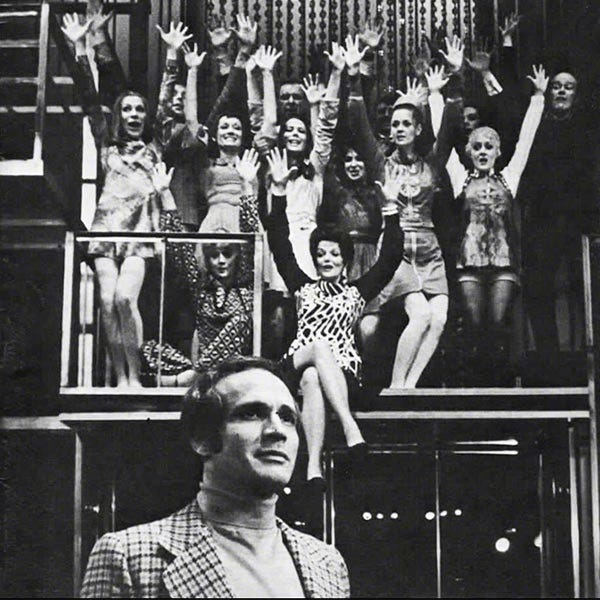
“Company” is the opening number of Stephen Sondheim’s 1970 Broadway musical of the same name. It changed my understanding of music, my career, and my life.
As Broadway nerds know very well, “Company” is a funny, thoughtful, pretty much plotless musical about a guy named Robert: still single at 35, navigating dating, friendship, and marriage.
“Company” was also my first job. In 1980, the summer I turned 17, I’d been hired to play keyboard in the pit orchestra for “Company” at a community theater. I had never heard of “Company” or Stephen Sondheim.
The trouble started the day the musical director dropped off the piano part. I opened the book and tried to play the opening measures:
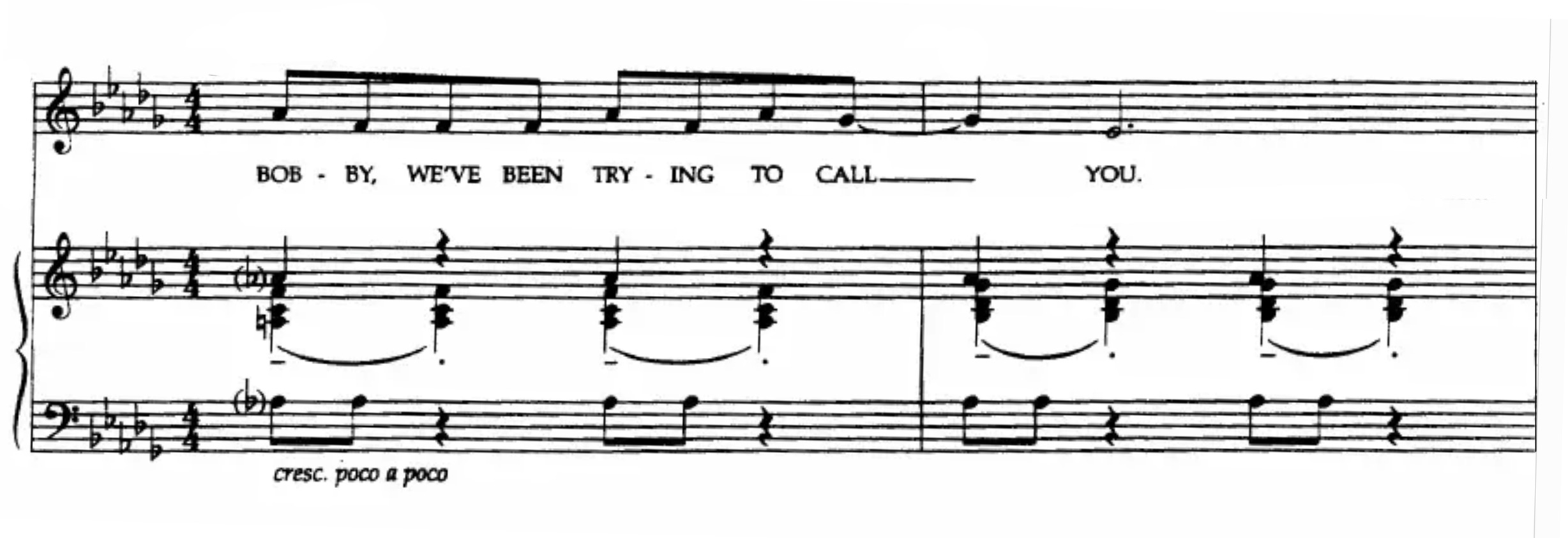
Look at that first chord. What the hell is that? An A-flat right next to an A-natural? That’s like mixing milk and ginger ale.
I had never played dissonances like this. To this day, I vividly remember sounding out the chord on the piano, putting one finger down at a time, trying to find out why it didn’t sound good. Was there a typo?
What the hell was this supposed to sound like?
I bought the “Company” cast album. When I played it, I finally understood: The very first thing you hear, before those dissonant chords, is a telephone busy signal.
In the opening number, Bobby’s six best friends are all calling him up to make plans:
Bobby! Bobby!
Bobby baby, Bobby bubi, Robby!
Bobby, we’ve been trying to call you,
Bobby, I’ve got something to tell you…
Bobby, we’ve been trying to reach you all day!
Bobby, there was something we wanted to say!
Now it all made sense. This Sondheim, this genius, had reproduced a busy signal using musical notes and rhythms. That sound brilliantly illustrated not only the lyrics (“We’ve been trying to reach you all day!”) but also Bobby’s emotional state: unreachable.
Playing Sondheim’s music is hard. He’s fond of keys with a million sharps and flats (the song “Company” is in D-flat major) and super-fast note patterns that took me hours a day to get under my fingers.
But my god, this musical. It was profound, and funny, and beautiful. Sondheim took the songs into places they’d never gone before on Broadway. And the song “Company” also shows Sondheim the lyricist at his most spectacular. Most songs, if they rhyme at all, follow a line-rhyming pattern like this from Billy Joel’s “Piano Man”:
Sing me a song, you’re the piano man
Sing me a song tonight
‘Cause we’re all in the mood for a melody,
And you’ve got us feeling all right.
Lines 2 and 4 rhyme (“tonight” and “right”). Lines 1 and 3 don’t.
But Sondheim — oh my god. Look at the lyrics for “Company”:
Phone rings, door chimes, in comes company!
No strings, good times, just chums, company!
He’s got triple internal rhymes!! Each line rhymes three times with the previous one: “rings/strings,” “chimes/times,” “comes/chums.” And by the way, he built that with phrases only two syllables long (like “phone rings”). It’s much easier to make rhymes fit if your line is long. As a fledgling songwriter, my mind was completely blown.
That was an unforgettable summer. In that orchestra pit in Chagrin Falls, Ohio, I made three formative discoveries: Sondheim, the thrill of live theater, and a cute clarinet player named Sharon.
“Company” made me a musical-theater nut. That fall, I went to Yale, wrote a show every year, majored in music, moved to New York, and worked on Broadway shows for ten years.
I even met Sondheim. For the next 30 years, I was his tech-support guy. He paid me in Broadway tickets.
In 2006, they revived “Company” on Broadway. I could not wait to see it, to joyously sing along with every note I knew so well (in my head, of course).
But when they started playing “Company,” the song, I was stunned. The complex chords were there—but the busy signal was gone.
I was outraged. Didn’t these idiots understand Sondheim’s brilliance? Without the busy signal, what was the point of those insistent, dissonant chords?
I called Sondheim to report this travesty. He chuckled at my indignance and told me who was responsible for the change: him.
He had removed it.
“Nobody knows what a busy signal is anymore, David,” Sondheim said. “It wouldn’t make any sense to today’s audiences.”
I was floored. That hadn’t occurred to me. In the cellphone age, you don’t get busy signals; you get voicemail. 37 years had passed since Sondheim wrote that song. Sondheim was just updating the show for a younger audience, to preserve the show’s relevance for the future. And he didn’t seem the least bothered by it.
A Song For You: “Company” by Stephen Sondheim, performed by the New York Philharmonic (2022)
“Company” gets revived pretty often. Here’s the full song performed by the New York Philharmonic in 2022 with a cast that included Neil Patrick Harris, Stephen Colbert, Jon Cryer, and Patti LuPone. The busy signal is gone forever, but never mind that. Whenever I hear those opening chords, whenever I play those chords, I still think of them as a busy signal — and as the opening number of my adulthood.
You were Sondheim’s tech support guy??? What a charmed life.
The richness of Pogue's experience and writing shines again.